Nova and the Lost Planet of Colors
Young explorer Nova travels through a shimmering cosmic nebula to discover why a distant crystal planet lost its colors and how curiosity brings light back.
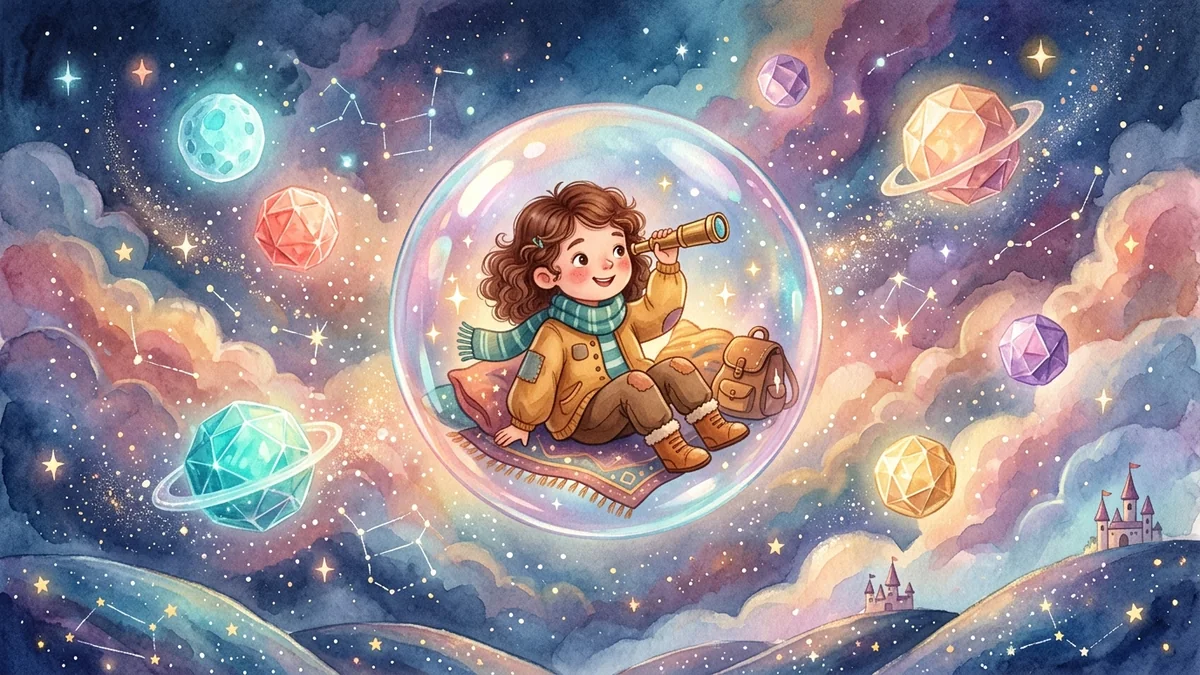
The Glass Bubble Ship
Nova kept a notebook filled with star maps under her pillow and a magnifying glass tucked in her pocket. One twilight evening, her iridescent glass bubble ship chimed with a curious signal from the edge of the Whirlpool Galaxy.
"Attention, Explorer Nova!" blinked the star chart. "The Planet of Prisms has gone completely gray!"
Stepping into her floating bubble, Nova zipped past swirling rings of turquoise ice and golden asteroids. Before long, a round world made entirely of smooth mountains and quiet valleys appeared ahead. Instead of sparkling like jewels, every hill looked dull and dusty gray.
Complete Story Transcript
Read-along & printable textThe Glass Bubble Ship
Nova kept a notebook filled with star maps under her pillow and a magnifying glass tucked in her pocket. One twilight evening, her iridescent glass bubble ship chimed with a curious signal from the edge of the Whirlpool Galaxy.
"Attention, Explorer Nova!" blinked the star chart. "The Planet of Prisms has gone completely gray!"
Stepping into her floating bubble, Nova zipped past swirling rings of turquoise ice and golden asteroids. Before long, a round world made entirely of smooth mountains and quiet valleys appeared ahead. Instead of sparkling like jewels, every hill looked dull and dusty gray.
Following the Dust Trail
Nova landed softly beside a crystal waterfall that stood frozen and silent. She tapped a clear rock gently with her glove. Tink.
"Why aren't you glowing?" she wondered aloud, pulling out her magnifying glass.
Looking closely through the lens, Nova noticed a fine blanket of dark space soot covering the mountain peaks. Earlier that week, a clumsy meteor shower had drifted by, leaving behind a shadow cloud that blocked the friendly nearby sun from reaching the crystals.
Catching the Starlight
A tiny round moon-beetle peeked out from under a fern, blinking shyly. "Without sunbeams," the beetle squeaked, "our prism rocks cannot split the light into coral, turquoise, and gold!"
Nova smiled. She knew from her science books that crystals need clean surfaces and clear rays of light to create rainbows. Together with the beetle and a dozen curious rock-sprites, Nova opened the solar mirrors mounted on her glass bubble ship.
First, they gently brushed the dark space dust off the tallest spire using soft feather-dusters made of stardust. Next, Nova tilted her ship's curved glass roof to catch a bright beam from the nearest golden star and bounce it straight onto the crystal spire.
A Symphony of Rainbow Light
Whoosh! The moment the golden beam touched the clean prism rock, light exploded across the valley in waves of shimmering turquoise, warm coral, lavender, and amber! One crystal bounced the beam to the next, waking up the frozen waterfall until liquid rainbow drops splashed joyfully into the canyon below.
The moon-beetle cheered and danced across the glowing moss as the Planet of Prisms hummed back to life like a giant music box.
Before flying home, Nova sketched the sparkling crystal valleys into her notebook. Even the smallest beam of curiosity, she realized, can light up an entire world.
Moral of the Story
Curiosity and careful observation help us solve big mysteries and bring beauty back to the world around us.
Bedtime Discussion Questions
Engage your child with these gentle open-ended questions:
- 1Why had the crystal planet turned gray when Nova first landed?
- 2How did Nova use science and sunlight together to wake up the crystals?
- 3What colors would you want on your own imaginary planet?
Word Bank & Vocabulary
New words to explore together during reading time:
Recommended Stories
Discover more amazing stories and continue your reading journey ✨